 Issue #1 · February 2026
It's February 2026, and honestly we're still catching our breath from January. New models from Anthropic and OpenAI, a national AI sovereignty debate, and a widening gap between AI tool adoption and actual AI fluency. Behind the scenes, our team has been deep in it, helping organizations figure out what these shifts mean for their people, their workflows, and their strategy. We decided it was time to start sharing what we're seeing. This is our attempt to cut through the noise and surface what actually matters for BC business leaders. Because right now, making sense of AI is the job.

Canfor Corporation, one of the world's largest producers of sustainable lumber and wood products, rolled out Microsoft 365 Copilot last year. Licenses paid, tools deployed, green light from leadership. And then the thing that happens to almost every organization happened to them: not much changed. Most employees lacked confidence in how to apply Copilot to their specific work, and the IT team saw clearly that without structured training, they weren't going to get real value from the investment.
Between September and November 2025, we ran a three-session training program reaching 50 employees across Finance, IT, HR, Operations, and Sustainability. Every session was built around hands-on exercises using participants' actual work contexts, and we deliberately mixed departments together. That cross-functional bet paid off: participants consistently said that seeing how colleagues in other areas use AI sparked new ideas for their own work.
The standout was Copilot Agents. Once people saw they could build a custom AI assistant tailored to their own work (an HR policy bot, a project documentation tool) it changed how they thought about AI entirely.
"Most value was the mindset change, moving from seeing Copilot as a one-off tool to treating it as a collaborative partner."
– Finance participantThe bigger lesson is one we keep seeing: the gap between having AI tools and getting value from them is almost always a people problem, not a technology problem. This is exactly why the AI skills conversation matters so much right now. More on that below.

a16z called it "the hottest job in tech." Job postings for Forward Deployed Engineers at companies like OpenAI, Anthropic, and Databricks were up 800 to 1,000% last year. An FDE is a hybrid of software engineer, business consultant, and implementation specialist who embeds directly with customers to make AI products work in environments far messier than any demo accounted for.
The reason they're everywhere: AI products don't work out of the box for most organizations. MIT research found that 95% of AI pilots fail because of enterprise silos, not because the technology falls short.
We're seeing this firsthand. In our conversations with a provincial government agency, one of the biggest opportunities they're seeing is scaling from successful proofs of concept to production. No shortage of promising pilots. The challenge is making them work reliably, at scale, across real systems and teams. That translation layer is where most of the value gets created or lost.

Mark Carney's Davos speech in January set a new tone, positioning AI strategy as part of Canada's broader push for strategic autonomy and declaring the country would not "be forced to choose between hegemons and hyperscalers." It wasn't just rhetoric. The federal government has opened a call for proposals to build sovereign large-scale AI data centres (100+ megawatt capacity, submissions closed February 15), and AI Minister Evan Solomon is building a national strategy around four pillars: scaling Canadian companies, driving adoption, digital sovereignty, and trust.
There's a live debate about what "sovereignty" actually means in practice. Microsoft committed $19 billion to expand AI infrastructure in Canada, but the US CLOUD Act still allows American authorities to access data held by US companies abroad, regardless of where the servers sit.
For BC businesses: federal AI spending, data centre partnerships, Buy Canadian procurement policies. Real opportunities are taking shape, and new obligations around data residency may not be far behind.
are using AI
their AI investments
↑ 22pts since 2023
KPMG's latest Canadian survey tells the story in two numbers: 83% of employees want or need to upskill on AI, but fewer than half feel their organization provides adequate support. Indeed reports that only 29% of Canadian workers use AI multiple times per week.
And yet, when people get the right support, the results speak for themselves. In our work with a BC professional association, staff went from saving 15-45 minutes per inquiry to handling 20-30% more cases independently, without needing to escalate to their most senior team member. The pattern is consistent across our engagements: the gap isn't the technology. It's organizational.
Both major AI labs shipped significant upgrades in the past month. Anthropic's Claude Opus 4.6 introduces "agent teams" (multiple AI agents splitting tasks and working in parallel) with a 1 million token context window. OpenAI's GPT-5.3-Codex goes well beyond writing code, now covering the full software lifecycle: debugging, deploying, monitoring, writing specs, data analysis. They demonstrated it building fully functional games autonomously over several days.
The Claude release spooked investors enough to trigger a selloff in enterprise software stocks (Wall Street is calling it the "SaaSpocalypse"). Whether or not AI starts replacing traditional SaaS products, the direction is clear: AI isn't just assisting with work anymore. It's starting to do it.
Claude Opus 4.6 → GPT-5.3-Codex →Two major releases this month share a common theme: AI is moving from "ask me a question" to "give me a task." Anthropic's Cowork lets you point Claude at a folder on your computer and it can read, edit, and create files on its own. Meanwhile, Microsoft 365 Copilot now has "Agent Mode" in Word, Excel, and PowerPoint, actively editing your documents and reasoning through changes instead of just answering questions.
The interaction model is shifting. Both tools feel less like chatting with a bot and more like delegating to a capable colleague. If you have a Claude Pro subscription, try Cowork on your messiest folder. If you're on M365, watch for Agent Mode rolling out through February.
Claude Cowork → Copilot January update →Google's NotebookLM can now generate slide decks and infographics directly from your uploaded documents. It also got a major upgrade under the hood: the full 1 million token context window of Gemini 3, 6x longer conversation memory, and enterprise users can plug notebooks directly into the Gemini app.
Try it: Go to notebooklm.google.com, upload a pile of research docs, and ask it to build you a slide deck summary. It's free and genuinely useful for turning messy inputs into structured outputs fast.
Read more →Ethan Mollick's latest piece is one of the best summaries we've seen of what's actually changing right now. His core argument: management skills (breaking problems into tasks, delegating, quality-checking, setting context) are becoming the most valuable skills in an AI-powered workplace. The people who are best at working with AI aren't the most technical. They're the ones who know how to direct work.
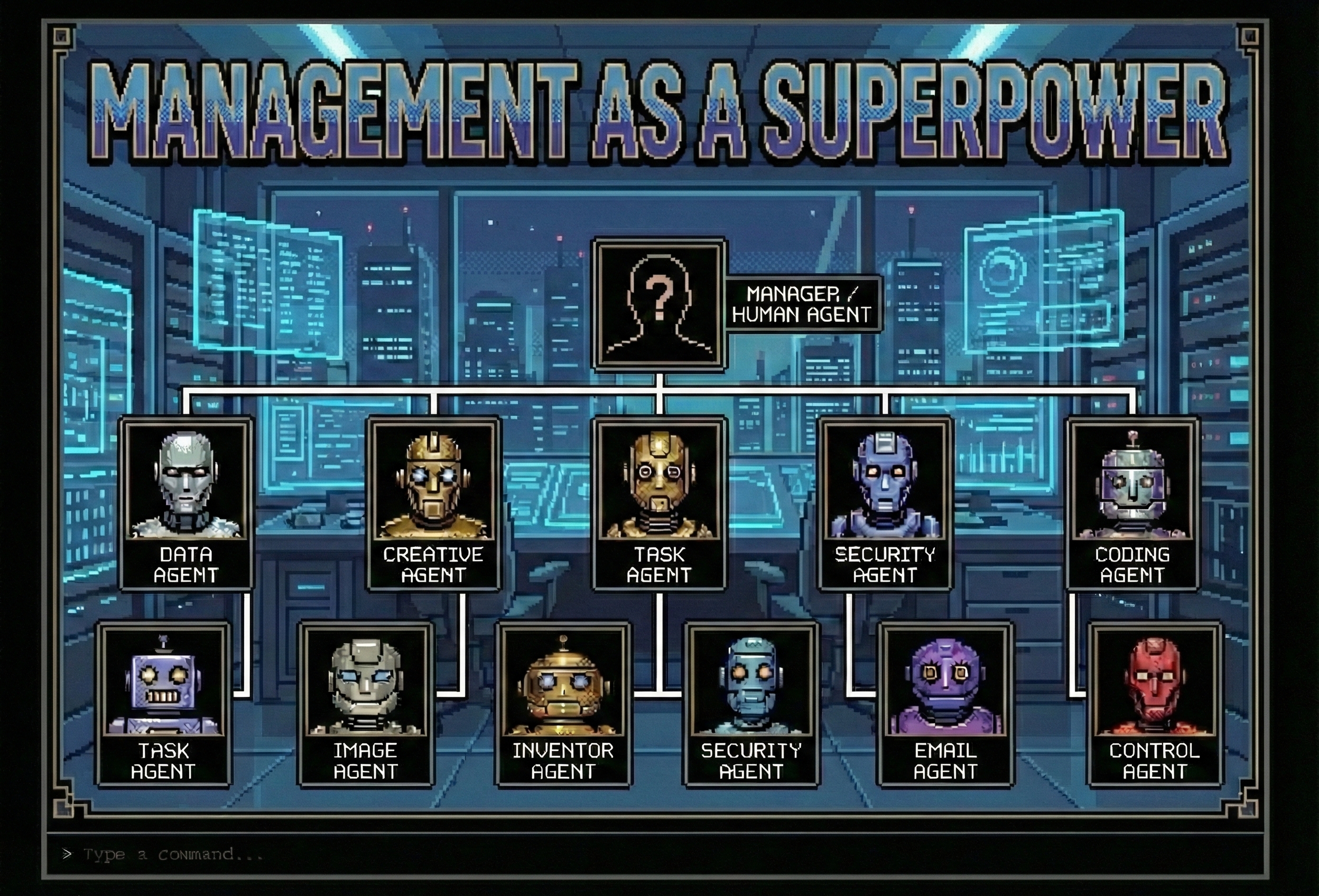
If you read one thing this month on AI and leadership, make it this.
Read it →We've had some incredible new talent join the team over the past few months, and we couldn't be more excited about what's ahead. Here are a few of the people helping propel us forward.



Thanks for reading the first edition of Making Sense. If you have suggestions for future content, or would like to talk to us about identifying the right next move for your organization, get in touch.
If this was forwarded to you, subscribe to future issues here.

Sense & Motion Inc. #200 – 410 W Georgia St, Vancouver, BC